

The Supposed Sin of Holocaust Denialism
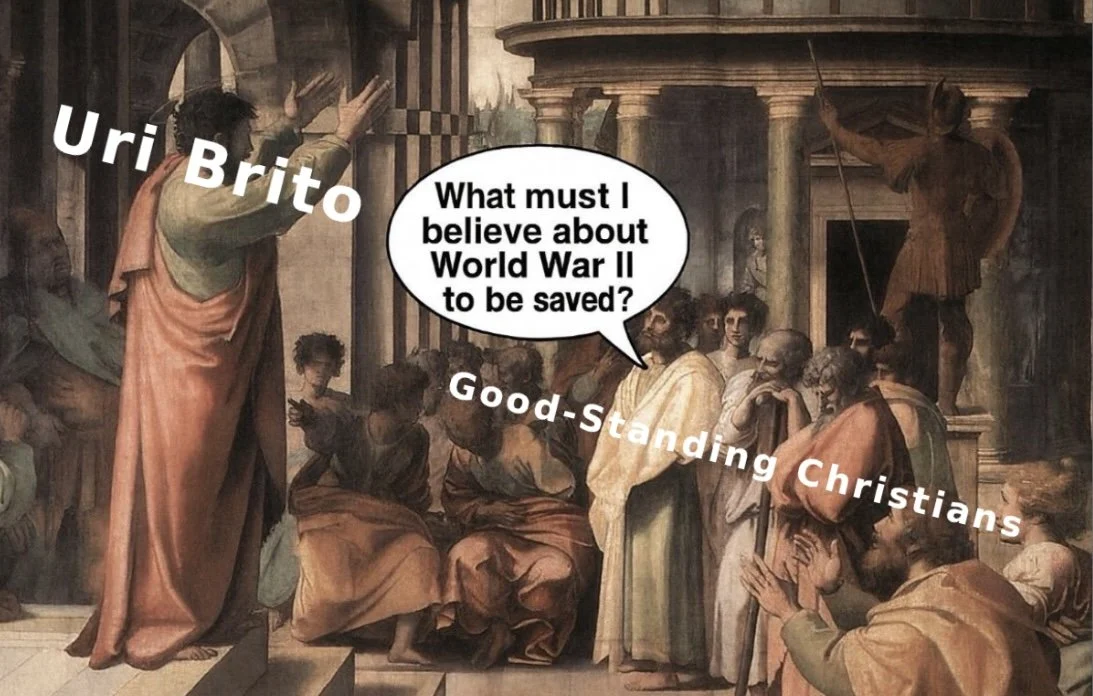
Takeaways from Uri Britto’s post, which declares that denial of any sort of the Holocaust event could send one to hell.
The Supposed Sin of Holocaust Denialism
Uri Brito, a pastor and the Presiding Minister of Council for the Communion of Reformed Evangelical Churches (CREC), posted a warning against Holocaust Denialism on Twitter (X). Out of clarity, I will attach his post in its entirety and then add my general summary and commentary following the quote:
_____________________________________________________________________
“I've been contemplating the concept of denialism lately and why it has been accompanied by sociological factors. Among them is the consistent consequential behavioral dynamic among these denialists. I think there is something to this relational turmoil worth observing.
The reality is that history teaches us that denial rarely begins with ignorance. It begins when truth becomes too heavy to carry and must now be passed on to a larger, weightier scapegoat. When a person senses that acknowledging reality would require repentance, responsibility, sacrifice, or judgment, the temptation is not to confess but to rename, to soften, to explain away. Holocaust denial, for instance, did not emerge because evidence was scarce. It emerged because moral accountability was unbearable. Language was cleansed, skepticism was selectively applied, scholarship was mimicked, and over time, memory was intentionally thinned. What once cried out from graves was eventually reduced to footnotes and debates. Just questions, says the inquisitor. But questions carry moral character with them.
If the past is any guide, we should expect the same pattern to repeat itself whenever a society awakens to a great wrong. Imagine a future, fifty years from now, when abortion is broadly recognized as a grave moral evil. Denial would not take the form of celebration or bravado. It would be quieter, more respectable, more pastoral-sounding. It would speak of “healthcare” and “tragic necessity.” It would insist that personhood was unclear, that everyone meant well, and that legality must surely have implied morality. Numbers would be blurred. Responsibility would be diffused because no one wishes to bear such guilt. Compassion would be redirected away from the smallest and most silent victims.
There is a difference worth noting. The Holocaust required secrecy because its perpetrators knew it was wrong. Abortion required redefinition so it could be defended openly. But the purpose of both narratives is the same: to make peace with ourselves without repentance.
Denial is never finally about facts. It is about the soul’s attempt to survive without confession.
The question before us is not whether future generations will judge us. They will. The question is whether we will tell the truth clearly enough now so that it cannot later be denied.”
- Uri Brito
_____________________________________________________________________________________
Here is my general summary of this post:
Holocaust denial is a sin, and those who hold such views are morally responsible, not only now, but even 50 years from now, for the potential impact of their positions on the world. Brito argues that denying the Holocaust is morally equivalent to those who deny the evil of abortion by redefining it as "merely healthcare," a "tragic necessity," or claiming we didn't fully understand personhood and bodily autonomy at the time, urging believers to speak the unvarnished truth clearly today so future generations cannot easily rewrite it.
.
This is a false equivalence.
Lack of Definition: What Counts as "Holocaust Denial"?
Brito provides no clear definition of what he means by “Holocaust denial.” His post goes straight to the damning consequences of possessing such a mysterious viewpoint. If this "sin” is really as extreme as he claims, wouldn’t providing a clear outline as to what qualifies and does not qualify as “denial” be appropriate? Some basic questions that could be answered are the following:
Is someone a denialist if they believe no Jews were killed at all?
Or is it denial if they believe the number was 5.9 million instead of 6 million?
What about 5.8 million, 5.7 million, 4 million, 2 million, or less than 1 million?
What exactly makes someone a “Holocaust denier”?
Would it be equally fair to label those who consistently try to change the narrative by adding to the death toll or introducing new circumstances as “deniers” too? After all, they are denying the original historical narrative by inflating it with even more deaths and atrocities over time.
No definition is given, but the sentiment seems to be that any revisionist questioning of the narrative is wrong, sinful, requires confession, and carries eternal consequences—along with hints of earthly consequences (gaslighting through fear) if one fails to accept this exact post-war consensus framing.
Laying Out and Critiquing Brito's Argument
I want to lay out his argument, break it down, and show the ignorance and danger in claiming there is an underlying controlling method that dictates how people think about history, while he falsely equates disagreement with a need to repent.
He implies that people must repent for holding a different view of a historical event in which none of us were alive, none of us (in America) were even on the same side of the planet, and where there is a severe lack of consistent written documentation from Germany, conflicting survivor stories, conflicting evidence (such as the Red Cross examination), conflicting accounts from those who entered the camps early, and no conclusive evidence of gas chambers in some cases.
My point is that there are enough holes in the narrative for reasonable people to not fully accept what has been taught for the last 80–90 years. The dominant narrative has become so popular and ingrained in our society that it exerts control over our thoughts. This began projecting outward after Israel was established in 1948, conflating into our political stream through dispensational ideology—which is, at its core, a Jewish-influenced theology—used merely as a source to sustain certain livelihoods.
Dispensationalism is not the only influence arising from this viewpoint on the Holocaust, World War II, and Germany as the greatest evil that has ever existed (with Hitler as the ultimate embodiment of evil).
We have been taken over and propagandized, and people are tired of pretending it is not happening. That is why the holocaust narrative is in question. It is not because of emotionalism, but because the “historical facts” are as transparent as Swiss cheese.
The following section will consist of the “questions and patterns” that are mainstream enough, I think, to warrant mass approval for why someone may be questioning the history of the holocaust. It is because of the influence that has followed, and the web of lies and efforts to preserve and protect it. This set of eight points is to show that there is a reason to be skeptical of this historical event, and it is not a sin to notice these rather mainstream realities of the Jews and thus WWII.
Here are eight points to warrant permissible questioning of this period in history:
1. Disproportionate influences in Media and Entertainment, which includes news organizations, television and movies through Hollywood, pornography, visual art, music production, and the underlying narratives and programming such powerful uses of media successfully implant over even short periods of time.
2. Banking ownership and influences of interest rates through the clear sin of usury, essentially making each individual a slave, paying a lifetime to likely never owning anything, nor being able to biblically provide and hand down an inheritance for one’s children and family.
Funding major social movements through positions or financial influences:
3. 19th Amendment —The New York 1917 Suffrage Referendum is often seen as the tipping point for the federal amendment, in which 78 of the 100 districts that voted in favor of suffrage were considered “overwhelmingly Jewish”.
4. The Civil Rights Act (over 600 Jewish organizations in America promoted BLM in the last decade, showing not only widespread but far-lasting ambition of dominating thought on this issue since the 1960’s).
5. Revolutionary Jewish scientists and psychologists who brought about the sexual revolution in the early twentieth century through their “work” such as Magnus Hirschfeld who was a Jewish doctor who founded the World League for Sexual Reform (1928) which advocated for sexual equality, birth control, and challenged the societal norms around homosexuality, Wilhelm Reich who was a student of Sigmund Freud who argued for sexual freedom as a path to human liberation, Lana Levine who was a psychiatrist and physician who pioneered birth control and sexual education services and books which influence today our public school Sex-Education programs, and Charlotte Wolff who was a physician, sexologist, and early feminist who wrote later in life in the 1970’s Love Between Women and Bisexuality, which are one of the first studies on lesbianism and argued bisexuality was the natural human state and that heterosexuality was “brainwashing”.
I can keep going, but I think you get the idea (many of these early documents, writings, and books by them and their peers were seen as “degenerate” by Nazi Germany and are a framework of their entire mindset in what we know of the books the German government rightfully burned to rid themselves of their influence. I point out this rabbit trail to show that there are no clear-cut, black-and-white, fully good-versus-fully evil entities at play in this conversation. Germany was right on some things, this being one of them, and it is important to see that they were right to show that this mindset given by Brito is a caricature of reality, of moral good and evil.
I wonder why that is, seeing as that every single thing Germany did was from the very pits of hell, and there is no argument to be had. Anyways, here is my interaction with Grok AI on this evidence. Given that AI’s programming leans liberal, I think the nature of the question I asked is intended to be neutral, and I think the outcome of what is revealed proves my points well.
Below is a list (provided by Grok) of the types of books involved in the Nazi book burnings. These books cover all genres of liberal support and are still considered culturally important and revered by modern liberals.
Q. “Hey Grok, give me a list of the genre of books the Nazi’s burned during WWII. Provide just the list.”
A. Here are the main genres and categories of books the Nazis burned during WWII (1933 book burnings and subsequent censorship):
Marxist/Communist literature
Socialist literature
Pacifist literature
Liberal/democratic writings
Jewish-authored books (all genres)
Works by Jewish intellectuals and scientists
Freudian psychoanalysis
Sexology and sexual reform works
Avant-garde/modernist literature
Expressionist literature
Dada and surrealist works
"Degenerate" art criticism
Foreign (especially French and English) modernist novels
Anti-militaristic novels
Weimar-era cabaret and satirical writings
Works promoting democracy and human rights
Books on socialism, anarchism, and class struggle
Writings by political opponents (especially left-wing)
Books on homosexuality and gender studies
Critical works on nationalism and militarism
(The lists targeted roughly 150 authors, but the genres above represent the overwhelming majority of burned books.)
I then followed up with one more question, which I will show below, and then I will move on to point 6:
Q. “Hey Grok, what percentage of these burned books would be revered today by liberalism? Percentage only.
A. 95-100%
You don’t say?
6. Lead proponents of LGBTQ propaganda (through hundreds of American-located grant organizations, non-profits, community groups, and synagogues)
7. Political positions through appointed positions and bought and paid for influence of American-born politicians, churches, and their doctrines through the likes of the Herzl Institute’s nation-wide funding of brainwashing 1000 Christian pastors to take Israeli talking points back home to congregants (to try and hold on to the post war consensus’s narrative power)
8. Finally, through our education, to enforce and demand that this narrative be protected and implemented into ongoing generations of Americans. All of these instances are statistically impossible for such a small minority to hold such a vast percentage of power and influence over society, yet that miracle has happened hundreds of times.
The modern follow-up and takeaways from these mainstream realizations:
There is an enormous elephant in the rooms that make up the typical American experience—rooms that every American moves through daily. Like the rooms in any house, these spaces are all connected. Yet for nearly eighty years, we failed to notice the giant elephant quietly occupying each one of them. Only now are people beginning to see that their rooms are connected, that the same elephant stands in every room of their home, and to ask why that is and when it began. For decades, Americans were assured that the elephant does indeed exist, but that he is certainly not in their home and that, in any case, his presence has no real impact on their lives.
Brito’s ideas, therefore, amount to a caricature of what likely happened and what is now being uncovered, debated, and redefined.
It is the same simple caricature that is taught in every 5th-grade social studies class: Germany = bad, Hitler = Satan, Nazi’s = demons.
Never mind the fact that Germany was 95% Christian and America was 90% Christian during 1940-1945.
Yet, as covenant Christians, we seem to all of a sudden know the fate of the salvation of tens of millions of Christian brothers across the Atlantic, nearly a century ago. When it comes to our caricature enemy of a particular past historical event, we can apparently put on salvation goggles and see as clearly as God sees, identifying not a point of infallible Scripture, not the Apostle’s or Nicene Creed, not even the Westminster Confession of Faith or Three Forms of Unity, and not even a founding father and theologian of the faith, but in discussing WWII and the holocaust, all opinions are off, no discussion can be had, no difference in conclusions can be made without being in sin.
That is the ridiculous point that is being spewed. By the head of the CREC, mind you. If this line of reasoning and concrete denunciations continue within the denomination, it will lead to fracturing. I do not want that.
Why does this act of redefining this historical event so profoundly disturb those who defend the post-war consensus? Why are we now observing so many non-dispensational Christians so hostile toward revealing this historical event? And what, or whom, are they ultimately trying to protect?
The Dangerous Claim of Moral Responsibility for Questioning
Brito states that denial begins with ignorance: it starts when the truth becomes too heavy to carry, so it must be pushed away or scapegoated. When a person senses that acknowledging reality requires repentance, responsibility, sacrifice, and judgment, the temptation is not to confess but to explain away.
In essence, he is saying:
Holocaust denial occurs because people are weighed down by fear and guilt over their beliefs. They think the opposing evidence, often presented in a polarizing way, has flaws, and we should examine that. Believing this is too much to handle, so they avoid confessing it to God because the burden feels overwhelming.
The shame of believing is what drives them; THAT is why I question—and not the many conflicting pieces of evidence, documentation, and personal stories. No, none of that is why you’re denying, thinks Brito; it’s because you are overwhelmed by sin and guilt.
I hope my sarcasm came through, but I believe it helps illustrate the severity and the ludicrous, yet dangerous nature of his statement. The idea that somehow we are morally responsible for the Holocaust.
I will be charitable here and say I don’t think Brito would claim that individuals are personally responsible (with none of us having been alive and all), but he implies that denying certain facts about the event carries moral weight that requires repentance before God—or else what? Will I go to hell for such a view? Will I be excommunicated? What are the ramifications that are being implied?
Brito claims it is not for lack of evidence that people deny; rather, they don’t want to be morally responsible.
He is right that questioning carries moral character implications, but the real issue is that this event is so laced with influence over how the Western world (especially America) has been shaped: the outcomes granted to the Jewish people, the labeling of the Axis powers (particularly Germany and Hitler) as ultimate evil, and the narrative that America is always the savior and hero and Germany always satan and the villain are not necessarily being bought anymore, and people are now losing various forms of power because of it.
In 1945, Germany was approximately 95% Christian, while the United States was about 90% Christian. Yet we rarely hear about the tens of millions of Christians who died in Germany at the hands of Allied forces. We focus on certain groups and caricature labels to make history easy and paint everything in a clear-cut “fully” good-versus “fully” evil divide, ironically always placing ourselves on the side of the former.
This is the acceptable form of our “history,” and while it is not my point to dog on America, my point is that questioning whether the clear black and white caricature that was programmed in us could have, if I may, some nuance, or difference of opinion, or validity of evidential claims is labeled as denial. And because you are in denial of these events, you are in sin.
Now that parts of the truth are being revealed and the controlling mechanisms are being exposed, many don’t like it and they are doing their own equivalent that the Herzl Institute over in Israel is doing with our pastors and their congregations, trying to control the narrative and by controlling the narrative, controlling the flock, and by controlling the flock, controlling positions of power and influence for various means to that end.
The tables have turned, the elites are frightened, and they are lashing out with all kinds of control—using scare tactics, threats of needing to repent, and equating disagreement with eternal damnation over a conflicted-evidential historical event which none of us lived through.
Abortion Is a False Equivalence
Brito tries to use abortion as a modern equivalent, stating in summary: In 50 years, when everyone will likely recognize abortion as a great evil (just as the Holocaust is seen as a great evil, with supposedly 6 million Jews horrifically killed), people will soften it.
These two are not the same—not even close. Again, this is a sub-tactic within the larger tactic that is his post. He is using abortion as a “gotcha” slur, similar to when liberals call people “racists, " " homophobes or Nazi’s”. By attaching the abortion issue as a just and equal weight against the Holocaust, he is implying that those who have disagreements about the Holocaust would also have disagreements on abortion, thus placing them in sin. This is my first point in this section, to show that he is using this comparison as a weapon to try to bring what is not a permissible sin (Holocaust denial or revisions) and placing it in the same category as slaughtering babies in the womb with abortion (a categorical sin of supporting such a cause).
My second point is showing how these two are not equal:
While any atrocity is horrific, there are degrees to awfulness, just as there are degrees to sin. Even if the argument is factually plausible, there is no Scriptural warrant nor degree of severity warrant for tying a connection-bow around these two events.
First, you are equating a potential genocide of up to 1 billion babies (abortions in America’s history, ranging from 700 thousand to over 1 billion depending on estimates) with 6 million Jews in the holocaust (presuming the historical narrative of that number is true).
Second, even presuming the 6 million figure is accurate, it is a ridiculous comparison to the potentiality of a billion American lives lost as infants, and the tens of millions, and the projection in some studies up to fifty or sixty million Christians who died in WWII from both Allied and Axis forces.
Third, I think it is appropriate to bring up how the 6 million Jews is the only talking point ever brought up by elites trying to control this narrative. If this is true, again, it doesn’t minimize the significance, but it is shocking how the lives of Christians who died in the war are widely known and often not of any concern, and do not hold to the same rules of sinful deniability that the 6 million Jews possess.
Fourth, it is more likely, given Germany’s 95% Christian population compared to America’s 90%, that the main antagonist of WWII, in terms of percentage of demographics in their ranks, were the one’s who lost the highest amount of Christians in the war in percentage and in quantity (given that it is estimated around 5.5 million German deaths to around 400,000 Americans).
Fifth, abortion has been around since the beginning of the twentieth century; it is not a problem of merely today, but one that was created by the likes of liberal minds. So if abortion originated and was practiced in the past, it is a product of the past, not our time.
Given this, the “blame,” so to speak, is on those who let it grow and did not destroy it before it was given the life and influence we know it has today. However, as I previously noted, there was a particular country in Europe that sought to end such practices and destroy their teachings and their essentially religious “high places”.
Brito states: “Denial is never finally about facts. It’s about the soul’s attempt to survive without confession.”
So far in this blog post, I have pointed out a few facts. Am I still in danger of sin? Am I attempting to survive without a necessary confession for my stance on this issue?
Key Objections to This Claim
The argument against the Holocaust narrative is consistently about disproving facts; it engages deeply with statistics, personal accounts, records, media evidence, etc. Claiming it is purely emotional is false and a blanket statement that fails to engage honestly with the work many are doing. In fact, the reversal could be said about Brito’s post: no specific arguments or examples are given to bolster his claims. It is easier this way to condemn those outside one’s perspective. It is the same move the media, organizations, higher learning institutions, etc have made over the last decade with words like: “Racist, Nazi, Homophobe, Transphobe, White Supremacist”, and so on.
If you gain anything from this blog, gain this sentiment:
I would never say someone who holds a different position on the Holocaust is in sin, condemned for their view, or is a moral equivalent to an abortion supporter. It seems ridiculous to have to even make this argument, but here I am trying to be reasonable.There is no need for repentance for someone who simply disagrees about the Holocaust or World War II.
This issue is not inherently a core theological matter. However, it involves tangible evidence, such as personal stories, that has been deliberately omitted from the accepted historical narrative over the past 80 to 90 years. Many people are starting to realize that our understanding may have been fundamentally mistaken in various aspects of the timeline, especially considering how dramatically the world has changed in the last century—changes far greater than those in the thousands of years prior.
These changes are not only technological but also systemic, as control over society has been exerted through churches, government leaders, public schools, and other institutions. This manipulation was carried out intentionally, as I have previously outlined. Therefore, patterns of intentionality require investigation into the origin of the issues and problems that appear to stem from it.
This is an honest method of investigation that is understandable to everyone. It just happens to be playing out on a global scale because the stakes of power are so high.
Final Thoughts: Fear Not
This post will likely scare women, boomers, and some younger individuals who are rightly afraid of losing their job or church in challenging the thinking of the post-war consensus—especially within the CREC denomination, given this is being said from the top down. However, it will not intimidate me.
As mentioned previously, I hold no angst or ill-will feelings towards those who arrive at different conclusions about the Holocaust, Germany, Hitler, or WWII in general than I do after weighing both sides of the evidence.
What I will hold accountable is this claim made by Brito that disagreeing on this past historical event is not permissible, and is not only that, but is a sin, and is not only sin, but you are the equivalent of supporting a billion American babies being mutilated in the womb, and you are not only an abortion equivalent, but are suppressing your guilt and harbored anger for “the Jews” which is the only logical conclusion for why you are running from confession and repentance on this issue.
That is what I take issue with.
Why must any disagreement on this event’s particular details be pushed so heavily?
Because this event has a massive influence over us.
It has caused insurmountable damage to the West, America, our families, our education, politicians, media, and entertainment. In short, we are different beings because of this event and the narrative that emerged from it. We are all heavily influenced by products of this global narrative, particularly in America and Western Europe. The weight of impact is incredibly heavy and has crushed all of us into the shape and makeup we are today.
As we look around our nation today, are we generally happy with the shape it's been molded into, largely by the various implementations post-WWII?
Lastly, as the head of a church denomination, if you try to close people off from asking questions by villainizing them and demanding repentance for simple, common-sense wonderings, you will find yourself splitting the denomination.
Individuals who disagree are not drawing a line in the sand—you are making the line in the sand, and pouring concrete over top to permanently solidify it.
Is this stand really worth as much as the Gospel, deserving such overreach of authority to control and suppress ideas?
Are you the one afraid of the confessional implications it may hold?
Time will tell.
Again, I harbor no ill will toward anyone holding a different view on this controversial historical event. I will not condemn brothers in Christ for it, nor seek to scare or destroy their church status, livelihood, or assurance of salvation over a highly conflated historical view with polar points of evidence and conclusions. This, to me, seems rather obvious, charitable, and frankly, sensible.
Brito is correct when he says, “future generations will judge us.” I will end with a list of points I hope to be judged for:
I hope to be judged and known for defending God-honoring Christians, not falsely condemning their views of history as a sin needing repentance.
I will not elevate a historical event to the moral level of Scriptural doctrine.
I will not call them the equivalent of abortion supporters.
I will not make them disavow anyone or their opinion on a contentious historical matter in which none of us were alive to witness.
I will not espouse what I declare is morally permissible thought on WWII and make it a concrete line-in-the-sand stance.
I will not gaslight people into a false confession of sin where no sin is found.
I will not seek to control others using such gaslighting and fearful tactics to maintain control over the church and its body.
This is an argument supported by concrete evidence, other evidential claims, and a genuine desire to understand where the great apostasy of our country spawned, how it did it, who did, who is still doing it, all for the purposes of gaining knowledge of those historical events, and to do whatever we can, Lord-willing, to see if it will help stop the plague on our nation currently and to ultimately see that it does not happen again for our children and future generations.
If this trend among Mid-Eva elites continues, with the implementation of declaring false sins as sins, we (as the body of Christ will see church discipline in such areas, most certainly excommunications, and then, finally, a denominational split. This is not what I want, and this issue in particular needs to be discussed to preserve the CREC and its community of churches.
I hope we, as Christians, can agree on that much.